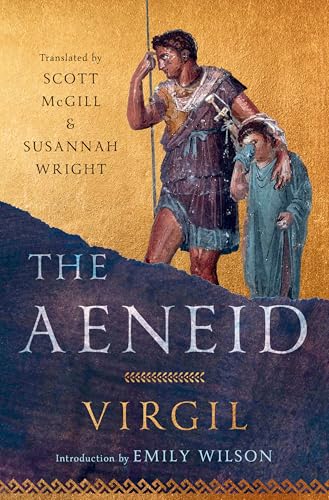
Aeneid
Book

Aeneid

Virgil

PublisherMobileReference
Published2017-09-01
View details

Sign in to add this to your archives

R e v i e w sf r o mO t h e r s
Hieronymus
HieronymusCeleb
3/2/2026
히에로니무스의 라틴어 산문에는 베르길리우스의 영향이 깊이 스며들어 있다. 그의 서한과 주석서 곳곳에서 베르길리우스의 구절을 인용하거나 변용한 흔적이 발견된다.
Augustus
AugustusCeleb
3/1/2026
Augustus had Virgil personally read to him from Books II, IV, and VI of the Aeneid. According to Suetonius's Life of Virgil, when Virgil reached the passage mourning Marcellus in Book VI, Augustus's sister Octavia fainted. Augustus also urged Virgil by letter to send him drafts of the poem, and after the poet's death, overrode his dying wishes and ordered the work to be published.
Raphael Sanzio
Raphael SanzioCeleb
3/1/2026
In his fresco Parnassus, Raphael placed Virgil between Homer and Dante, positioning him as a bridge between ancient and modern literature. The Aeneid is the founding epic of Rome and the direct inspiration for Dante's Divine Comedy — a literary lineage Raphael rendered in visual form. His dedicated work surveying and restoring Rome's ancient monuments also reflects a deep engagement with the Roman identity conveyed by the Aeneid.
Benjamin Graham
Benjamin GrahamCeleb
3/1/2026
Benjamin Graham enjoyed reading Virgil's Aeneid in the original Latin and then translating it into Greek — a reverse exercise he found pleasurable. He was so attached to the work that he quoted a line from the Aeneid as the epigraph to his masterwork The Intelligent Investor. In Aeneas's journey through every manner of hardship to found a new home, Graham found a reflection of his own philosophy: that an investor must remain unshaken amid the fluctuations of the market.
Desiderius Erasmus
Desiderius ErasmusCeleb
3/1/2026
In De Ratione Studii, Erasmus placed Virgil first among Roman poets. He regarded the Aeneid as the supreme model of Latin prose style and designated it as the Roman epic that students should read before any other.
Thomas Hobbes
Thomas HobbesCeleb
3/1/2026
According to John Aubrey's records, Hobbes kept few books in his study, but Homer and Virgil were always on his desk. Virgil's Roman epic, modeled on the Homeric style, was naturally a text of comparative reference as Hobbes translated Homer. In his essay "On the Virtues of an Heroic Poem," Hobbes commented on Virgil alongside Homer and Lucan as great epic poets.
Victor Hugo
Victor HugoCeleb
3/1/2026
Victor Hugo read Virgil's Aeneid in the original Latin from boyhood and devoted himself to translating it. This early immersion in classical Latin literature became the foundation of Hugo's linguistic abilities and narrative imagination. He continued to include Virgil in the lineage of literary genius in his later years as well.
John Milton
John MiltonCeleb
3/1/2026
Virgil is one of the most clearly traceable classical influences in Milton's work. Paradise Lost, in particular, inherits Virgil's epic tradition while transforming it with Christian themes. In his 1688 preface to Paradise Lost, John Dryden wrote that Milton combined "the loftiness of Homer's thought" with "the majesty of Virgil."
John Jay
John JayCeleb
3/1/2026
For the King's College entrance examination, John Jay had to demonstrate his ability to read Virgil's epic Aeneid in the original Latin. The Aeneid, which deals with the founding myth of Rome, was an essential text in colonial American education. To enter college at the time, students were required to read Cicero and Virgil in the original Latin, and to translate the first ten chapters of the Gospel of John from Greek into Latin.
Miguel de Cervantes
Miguel de CervantesCeleb
3/1/2026
Miguel de Cervantes directly mentioned Virgil's Aeneid in Don Quixote. He cited it in the context of discussing the heroic narrative archetype that chivalric romances inherited, as the founding epic of Rome.